
John Franklin-Adams (1843 – 1912)
Kintyre’s ‘dark skies’ are more popular than ever but I wonder how many stargazers know the name John Franklyn-Adams.?
The cover image is from a Postcard of the a 1903 view of the West Road and Machrihanish Bay, taken from Cnoc Sabhail. It also shows the Observatory behind Machrihanish House that was added by John Franklin-Adams.
Mr Franlyn-Adams was a frequent visitor to Machrihanish for golf and recreation and bought the house in 1897.
Mr Franklin-Adams created one of the earliest detailed, photographic atlases of the complete night sky, he initially conceived the idea of a photographic study of the Milky Way while living at Machrihanish but later expanded it to the whole visable night sky. The minor planets 982 Franklina and 1925 Franklin-Adams are named after him.
Machrihanish House was the first ‘Villa’ in the village. Built by Mr David Maxtone of Campbeltown in 1893, sold a few short years later to Mr Franklin-Adams. Incidently, Machrihanish House was also the first Private Boarding House in the village.
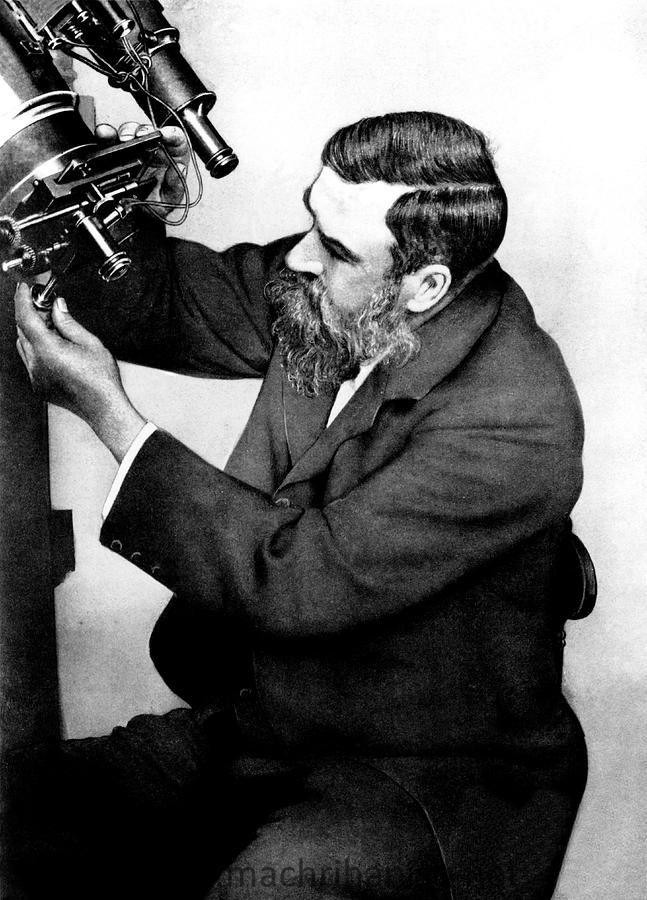
Obituary Notices: Fellows:- Franklin-Adams, John*
JOHN FRANKLIN-ADAMS was born at Peckham on 1843 August 5. He was son of the late John Adams, of Lloyds, and was educated first at the Blackheath Proprietary School and afterwards at Berlin and Havre. This Continental education, combined with subsequent travels in Spain, Italy, Russia, and Scandinavia, gave him a considerable command of modern languages. He was one of those men who, like South, Lassell, De la Rue, and many others, find themselves drawn, by a species of natural compulsion, into the pursuit of practical astronomy.
It was not until comparatively late in life that Franklin-Adams’ thoughts turned strongly towards astronomy; but when they did, and he came into contact with others interested in the subject, his imagination was fired, and he devoted a large share of his vigorous intellect and extraordinary energy to its pursuit.
In 1863 he began business at Lloyds, and finally became one of its senior members. He married in 1879 and took up residence. at Chislehurst, where his five children were born. In 1890 he moved to Wimbledon, and there began the practice of astronomy, for which he had from his youth shown a certain liking.
His early education and the engrossing character of his business occupations had not prepared him for such work; but the writer can never forget the enthusiasm with which he described the satis- faction he found in working out the theory and practice of the use of a transit instrument both in the meridian and the prime vertical. He had no instructor beyond a book, his instruments, and his own wits, and he declared that no one could really learn practical astronomy unless he began in that way and worked out things for himself.
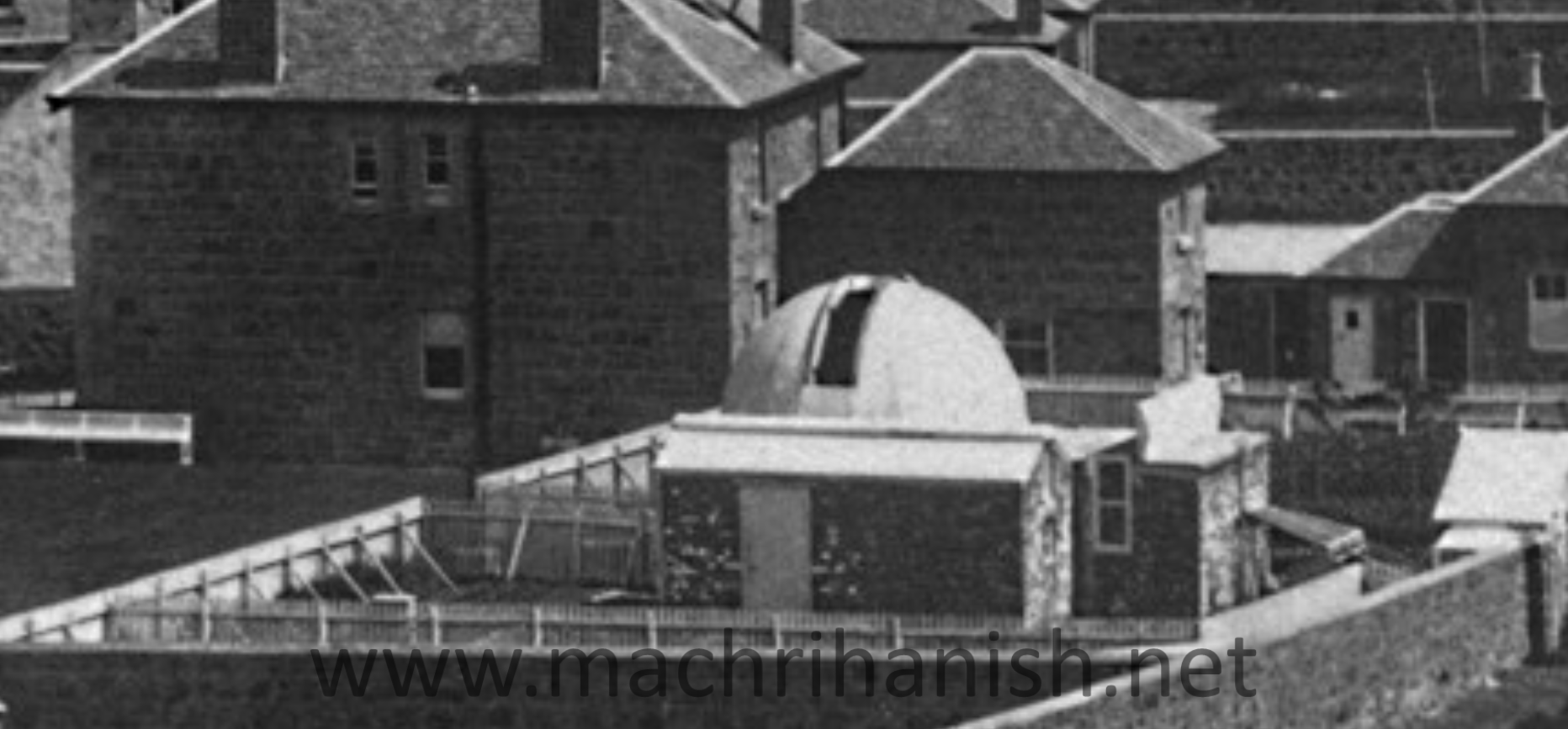
His first instrument was a 4-inch telescope, on a tripod stand, which he transferred to Machrihanish in Argyllshire, where he went from time to time for golf and recreation, and about 1897 he bought a house there to which he added an observatory. The 4- inch telescope was mounted on a stone pier; a 6-inch equatorial, a transit instrument with piers and bearings for use both in the meridian and prime vertical, and various clocks were afterwards added. He had been interested in photography from the time of the wet collodion plate, and it was at Machrihanish that he conceived the idea of making a complete photographic survey of the “Milky Way.”
He afterwards extended this scheme to the photographic charting of the whole heavens from north to south, and finally procured an equatorial mounting by T. Cooke & Sons consisting of a well-designed double polar axis of the English type, driven by a Repsold clock, with which he began to take the necessary photographs. This admirable mounting carried two triple photo- graphic lenses by T. Cooke & Sons, of 6 inches and 10 inches diameter. A full description of these will be found in the Monthly Notices for May 1904.
(For the Astronomers and technically minded: Link to Monthly Notices of the Royal Astronomical Society, Volume 64, Issue 7, May 1904, Pages 608–613)
In 1900 Franklin-Adams went with an observing party from the Royal Observatory, Edinburgh, under Professor Copeland, to Santa Pola, Spain, for the Total Solar Eclipse on May 28 of that year, which was successfully observed.
In 1902 Mr. Adams became very ill and was advised to make a journey to the Cape of Good Hope. He came there with the somewhat incongruous double purpose of curing the rheumatism and neuritis from which he suffered, and of photographing the southern heavens. He occupied rooms near the Royal Observatory during one half of each month, and during the other half of the month, when moonlight would fog his long-exposure plates, he went to the Sanatorium of Caledon, about 60 miles distant from the Observatory, where he took a course of baths from the celebrated hot chalybeate springs there. It was in vain that the doctor and his friends urged him first to complete his cure and then to do his astronomy-nothing would turn him from his purpose. He would come back from Caledon at the end of a fortnight greatly benefited, and undo a great part of that benefit by long exposure at night, to return as cheerily as ever to Caledon at the end of a fortnight. At first he could not dress without assistance or wash without difficulty and pain. His condition of health slowly improved, but his enthusiasm, optimism, and energy told against the permanent improvement of his health and the ultimate quality of his first series of Cape photographs. He had made a plan for doing his work which left no time for preliminary experiment, for his previous experience did not enable him to realise how numerous are the precautions, trials, and tests required to obtain perfect astronomical photographs with plates 15 square, taken with a telescope of 10 inches aperture and so short a focus as 45 inches.
The object-glass was a very fine one, the stand and clockwork practically perfect, but the mounting of the lens did not allow of its accurate centring and squaring, nor was the wooden tube capable of the necessary precise adjustment in permanent parallelism with the axis of the 10-inch lens. In spite of all advice he insisted that the work must go on before these things could be altered.
On his return to England in the spring of 1904, Mr. Franklin- Adams moved into a new house which he had built for himself at Mervel Hill, Hambledon, near Godalming, to which an observatory of suitable size was attached. Besides the admirable photographic equatorial by Cooke, already mentioned, the ‘observatory contained an equatorial by T. Cooke & Sons of York, having a twin steel. tube fitted with a 7-inch triple Taylor object glass and an excellent 8-inch object-glass by Wray, together with a 10″ objective prism mounted in such a way that it could be available for use with either of the object-glasses; a meridian circle by Jones having an object-glass of 3 inches aperture and 57 inches focal length; a prime vertical transit by Troughton & Simms with an object-glass of 3 inches; various clocks, a chronograph, and meteorological instruments. Here photographs were taken similar to those at the Cape, but with exposures of 2 hours 20 minutes, the extra 20 minutes being necessary because of the difference in quality of the sky. Extensive preparations were made for measuring and counting the stars on these plates and the work was begun, but not finished, by Mr. Franklin-Adams.
In 1905 he went with Professor Becker of Glasgow to Algiers to observe the eclipse of August 30, his son Bernard accompanying him, and on his return, the work of completing the negatives of the northern hemisphere and of making positives from them was pushed on with much vigour at Mervel Hill, as may be seen from the Reports in the February numbers of the Monthly Notices in 1908, 1909, and 1910. An apparatus for ruling meridians on these plates, preparatory to counting the stars, was made, and some experimental work of this kind was done. This apparatus and specimens of the photographs were exhibited at the Conversaziones of the Royal Society in various years. Difficulties were found, from dew-formation on the surfaces of the object glass of the telescope, which were overcome by an ingenious method described by Mr. Franklin-Adams in notes in the Monthly Notices, vols. lxx. p. 543, lxxii. p. 165. Eventually the plates taken at Mervel Hill. were found to be superior to those taken at the Cape in 1903-1904, and it was decided to repeat those of the southern hemisphere. Mr. Franklin-Adams was preparing to go to South Africa in November 1909, but a recurrence of his illness which had been. threatening spoiled his plans, and the 10-inch equatorial was sent to the Observatory at Johannesburg in charge of his assistant, Mr. Mitchell. The telescope was used to photograph Halley’s Comet in 1910, excellent pictures being secured: it has since been used to repeat plates of the southern hemisphere, the series having been completed by Mr. Innes, but Mr. Franklin-Adams was never able to use the telescope again. His illness increased, and he had to give up his observatory and his astronomy in 1910. In the next year he retired from business at Lloyds The 10-inch equatorial was presented to the Transvaal (now the Union) Observatory, the 6-inch lens has been lent to the Royal Observatory, Greenwich, and the photographs and micrometer designed by Mr. Franklin- Adams were handed into the charge of the Astronomer Royal. The work of counting the stars on these plates has been in progress at Greenwich for the past two years.
Before his death Mr. Franklin-Adams also presented the Cooke twin equatorial to the Union Observatory. The appreciation of such men as Kapteyn, Dyson, and others interested in cosmical astronomy was to Franklin-Adams an immense satisfaction in his latter days, and it is sad to think that he did not live to see the full outcome of the work, for which he had made so many sacrifices.
Mr. Franklin-Adams was a keen musician. In early life he acted as organist and choirmaster at All Saints’ Church, Putney,
He had in the building of which he was largely instrumental. been an active volunteer, taking part in many shooting competitions at Wimbledon, and went with a volunteer ambulance to the Franco-German War in 1870-71. He was a golfer and a Free- mason, holding high office in the Craft, and was twice Master of the Armourers’ and Braziers’ Company. He died at Enfield on August 13 last, at the age of 69, leaving a widow, two sons, and three daughters, and his ashes, after cremation, were buried there on 1912 August 16.
He was elected a Fellow of the Society 1897 April 9.
D. G.
Sources:
- https://www.britannica.com/topic/Franklin-Adams-Charts
- Monthly Notices of the Royal Astronomical Society, Volume 73, Issue 4, February 1913
* Copyright Royal Astronomical Society (shared here for educational purposes)


